
Beyond the Obvious
Recognising cardiovascular emergencies in endemic settings— plus meet our new leaders and enjoy the cardio fun corner!

Dear Cardiology Enthusiasts,
Welcome to our March issue!
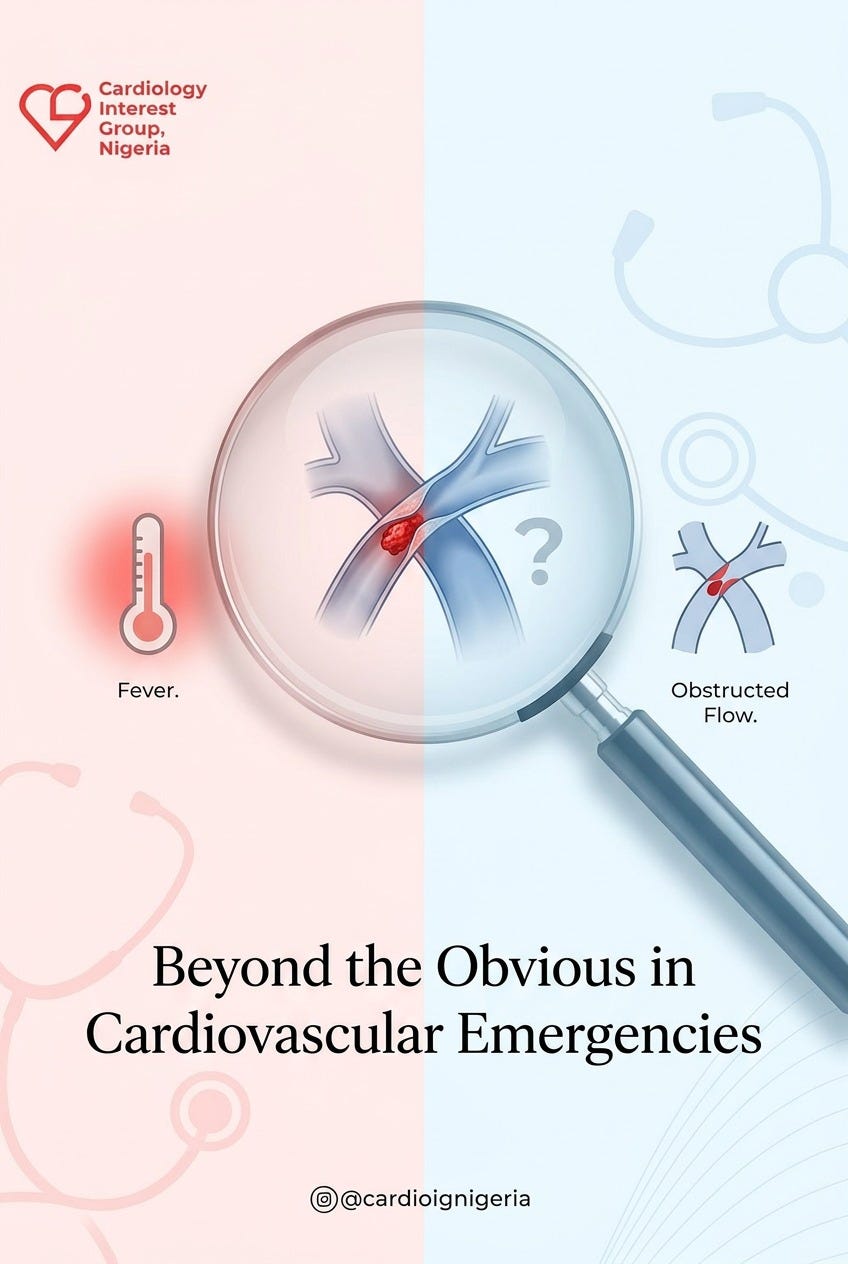
What happens when the clinical picture of a medical condition is somewhat less straightforward?
In malaria-endemic regions like Nigeria, fever frequently dominates the diagnostic landscape. Yet not all fevers point to infection.
In this month’s case story, we explore how a seemingly familiar presentation concealed a life-threatening cardiovascular emergency and how timely recognition made all the difference.
CASE STORY
When Fever Distracts from the Real Diagnosis
A 55-year-old previously active man was brought to the emergency department because of worsening difficulty breathing.
Two weeks earlier, he had sustained blunt trauma to his left leg while restraining a cow for slaughter. He did not seek hospital care. Over the next several days, his left calf became swollen and painful. Because of discomfort, he significantly reduced his mobility and spent most of his time indoors.
A nurse was invited to assist at home. The leg was bandaged, and on subsequent visits, gentle massage was performed to relieve pain.
About 10 days after the trauma, he began experiencing mild shortness of breath. His wife noticed he was breathing faster than usual, even at rest, but he dismissed it.
The following day, he developed a low-grade fever.
Given Nigeria’s malaria-endemic setting, malaria was immediately suspected. A blood test reportedly showed malaria parasites, and he was commenced on intravenous fluids and quinine therapy at home.
However, over the next 24 hours, his breathing worsened significantly. He became visibly distressed and unable to speak in full sentences. A home blood pressure reading was 153/95 mmHg, though his prior hypertensive status was unknown.
He was then taken to the hospital.
On examination at presentation: Respiratory rate: 30/min; Pulse: 118 bpm; Blood pressure: 148/92 mmHg; Oxygen saturation: 85% in room air. Chest examination was largely clear. However, his left calf was still relatively swollen and mildly tender compared to the right.
Detailed history led to a problems list of: Recent leg trauma; Prolonged reduced mobility; unilateral leg swelling; Acute dyspnea; Hypoxia and tachycardia
These raised strong suspicion for deep vein thrombosis with pulmonary embolism.
Upon investigations: ECG showed Sinus tachycardia; cardiac biomarkers were elevated; D-dimer was Elevated; Doppler ultrasound showed Left lower limb deep vein thrombosis; CT pulmonary angiography revealed pulmonary embolism in segmental branches.
Final Diagnosis: Submassive pulmonary embolism secondary to provoked DVT.
Management and Outcome
The patient was started immediately on:
Oxygen therapy
Therapeutic anticoagulation
Close cardiopulmonary monitoring
Because he remained hemodynamically stable, thrombolysis was not required.
His respiratory status improved over several days. He was discharged on oral anticoagulation with appropriate follow-up and counseling.
He survived largely because the underlying cause was eventually recognized and treated promptly.
Management Tip: When PE is strongly suspected, start anticoagulation immediately, provided there is no active bleeding or significant bleeding risk. Don’t wait for D-dimer, Doppler, or CT confirmation. Early treatment saves lives.
The Importance of Fever:
Fever significantly altered the clinical history of this case. In malaria-endemic environments like Nigeria, fever often leads to immediate antimalarial treatment sometimes before a broader differential diagnosis is considered, as seen with the home nurse in this case story.
However, Pulmonary embolism can also present with low-grade fever due to inflammatory response to pulmonary infarction and fever does not exclude thromboembolic disease.
Key Learning Points:
Unilateral leg swelling after trauma and immobility should prompt suspicion of DVT.
Massage of a potentially thrombosed limb may increase embolic risk.
Acute unexplained dyspnea with hypoxia requires urgent evaluation for pulmonary embolism.
Fever in malaria-endemic regions should not automatically narrow the differential diagnosis.
Early anticoagulation saves lives in pulmonary embolism.
Meet Our New Executive Committee
Over the past month, CIGN entered a new chapter of leadership. Following a structured series of interviews, a new set of leaders were appointed. It is our honour to introduce them to you.

Asogwa Chukwuebuka
President of the Executive Council

Princess Prause Calix Udo-Udofia
Vice President of the Executive council

Okeke Chibuzor Ifeanyichukwu
Programs Director

Okpalanozie Chiemeka
Financial Secretary

Abioye Peter
Student Liaison Officer

Marvelous O. Adelaja
Grants Director

Folusho Olu-Adegbola
Head of Media
In addition, we introduced themed Journal Clubs named in honour of renowned cardiologists. These clubs were created to represent and further our commitment to cultivating analytical thinking, research literacy, and leadership in cardiology. Here are the clubs and the newly appointed leaders.

Uche-Orji Christabel
Team lead “Renè Laennec” journal club

Ola-Daniel Samuel Olaoluwa
Team lead “Helen B Taussig” journal club

Oluronke Peculiar Ojasope
Team lead “Professor John Oluyemi Mabayoje” journal club

Matthew Aremu
Team lead “Ayodele O. False” journal club
With this dynamic team at the helm, we are excited for a year full of skill-building sessions, interactive activities, and community impact.
Cardio Fun Corner
It’s time to unwind a little. Let’s dive into this month’s Cardio Fun Corner for some trivia and tongue twisters!
Pulmonary Embolism Trivia:
Did you know?
1. Rudolf Virchow was among the first to recognise that blood clots forming in the veins can break loose and travel to the lungs, laying the foundation for understanding pulmonary embolism.
2. The development and widespread use of CT pulmonary angiography (CT‑PA) in the 1990s greatly improved the speed and accuracy of diagnosing PE.
3. Pulmonary embolism doesn’t always present with chest pain? Yes, some patients have only shortness of breath or mild fever, which can delay diagnosis.
Tongue Twisters:
Haha! Try saying these three times fast:
1. Deep veins develop dangerous drifting debris daily.
2. Massaging medial malleolar mishaps may mobilise menacing material.
Thanks for reading CIG’s Substack!
Follow us on our social media platforms via https://linktr.ee/cardioignigeria
Uchenna Ukaegbu & Favour Obukofe,
For The Newsletter team,
CIGN